Psychologist

Psychologists are trained in the science of human behaviour, cognition, and emotion, and apply evidence-based methods to assess, diagnose, and treat a broad range of mental health conditions.
If you enjoy seeing things from a scientific lens, are curious about human behaviour and think high-quality research is important, then becoming a Psychologist may be for you!
-
Psychologists apply the science of human thought, emotion, and behaviour to support individuals navigating psychological distress, mental health disorders, and complex life challenges. In clinical settings, they utilise evidence-based frameworks to promote recovery and wellbeing through interconnected core competencies. Psychologists’ work generally falls into the following categories:
Psychological Assessment: Systematic gathering of data through clinical interviews, standardised testing, and behavioural observations to evaluate cognitive and emotional functioning.
Diagnosis and Formulation: The synthesis of assessment data to identify specific conditions and create a "case formulation" that explains the underlying causes and maintaining factors of a client's distress.
Treatment and Intervention: The application of tailored, evidence-based therapies, such as CBT or ACT, designed to alleviate symptoms, build resilience, and monitor ongoing progress.
In Australia, psychologists work across a wide range of settings, including public mental health services, private practice, hospitals, community health centres, schools, universities, non-government organisations (NGOs), forensic services, and research institutions. In 2023–24, psychologists (including clinical psychologists) delivered 49% of all Medicare Benefits Schedule (MBS) mental health-specific services (AIHW, 2025).
Psychologists work with people across the lifespan, with rural and regional practitioners often working with a broader scope of presentations and roles that bridge clinical, consultative, and community capacity-building functions
-
The pathway to general registration as a psychologist is lengthy and competitive, and careful planning and consultation with the Psychology Board of Australia, AHPRA, and APAC-accredited course providers is recommended. As of March 2025, the Psychology Board of Australia are reviewing the pathways to practice as a psychologist, and we urge you to regularly check for updates via psychologyboard.gov.au.
Undergraduate
Becoming a registered psychologist in Australia requires a minimum of six years of combined tertiary education and supervised practice, regulated by the Psychology Board of Australia and the Australian Health Practitioner Regulation Agency (AHPRA) under the National Registration and Accreditation Scheme.
The first step is typically completion of a three-year Australian Psychology Accreditation Council (APAC) accredited undergraduate degree with a major in psychology, followed by a fourth-year program, either an Honours degree or Postgraduate Diploma in Psychology.
Clinical placement
Substantial supervised clinical practice does not typically occur during the undergraduate phase of psychology training. Following eligibility for provisional registration, supervised practice may occur through postgraduate professional psychology programs (e.g., Master’s or Doctoral training) or through the 5+1 internship pathway. At this point, a minimum of 1500 hours of Board-approved supervised practice is required (Psychology Board of Australia, 2024). This practice can occur across a range of settings, including public mental health services, hospitals, community health, schools, and private practice, and is supervised by a Board-approved supervisor.
-
Postgraduate / Credentialling
Following the fourth year of study and provisional registration, there are two current pathways to general registration as a psychologist in Australia:
The higher-degree pathway involves completing an APAC-accredited postgraduate degree, such as a two-year Master’s degree or a three- to four-year Doctorate. This pathway also allows graduates to apply for an Area of Practice Endorsement (AoPE) in a recognised specialisation area, including clinical psychology, counselling psychology, health psychology, forensic psychology, educational and developmental psychology, neuropsychology, organisational psychology, rehabilitation psychology, and sport and exercise psychology (APAC, 2022). Following the degree, graduates complete a Board-approved registrar program of supervised practice before applying for endorsement.
The 5+1 internship pathway involves completing an APAC-accredited fifth-year program followed by a one-year Board-approved supervised internship. Graduates of this pathway obtain general registration without an AoPE specialisation. Graduates can obtain endorsement in a specialisation later through additional postgraduate study and a registrar program. This pathway requires passing the National Psychology Exam prior to applying for general registration.
-
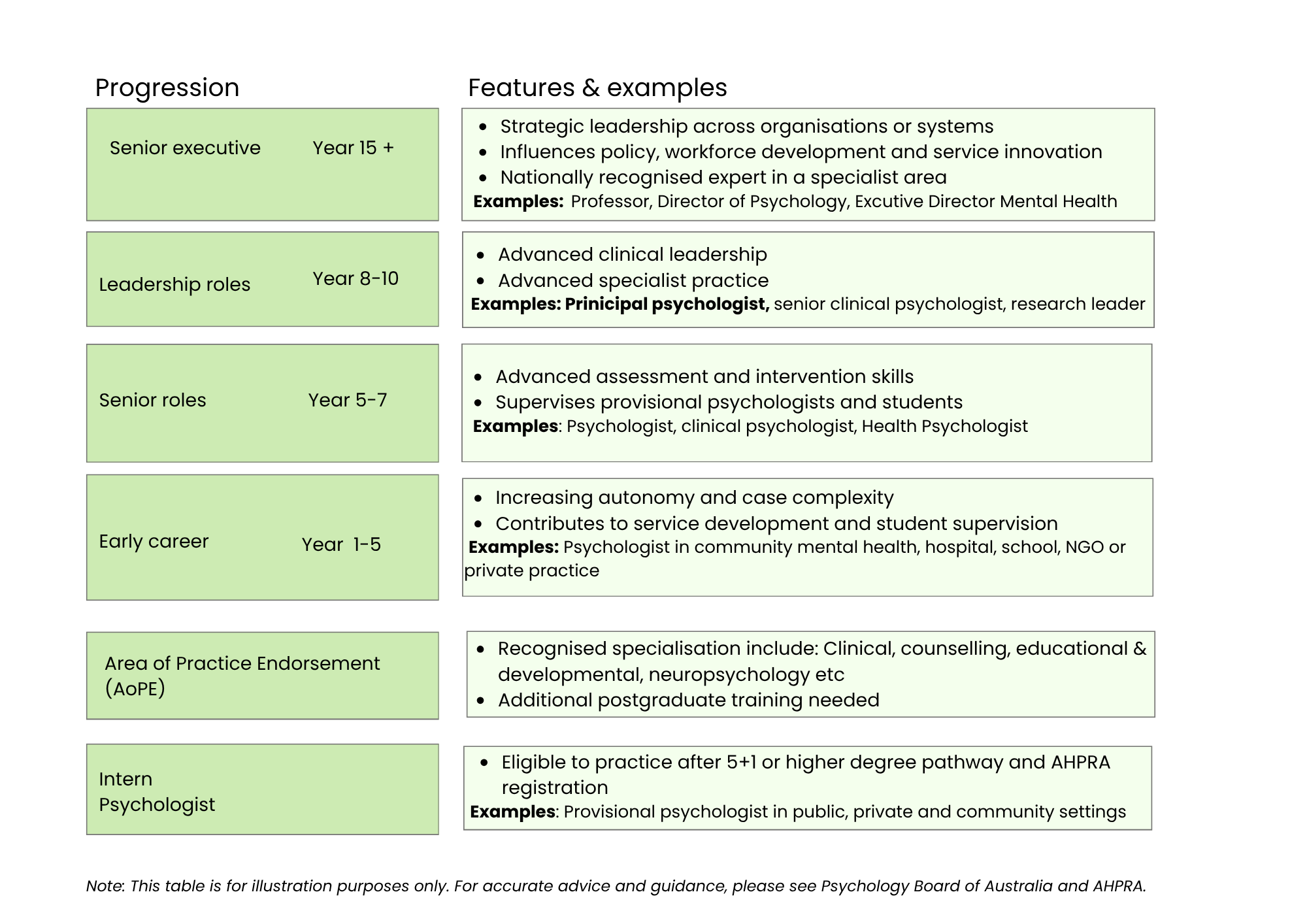
Psychology offers a diverse range of career pathways that can evolve significantly across a practitioner’s working life. Registered psychologists work in public and private health services, community organisations, NGOs, schools, universities, government agencies, research institutions, and private practice.
Private practice is a significant and growing pathway for psychologists in Australia, as they can provide services via the Medicare system under the Better Access initiative. Clinical psychologists may also access item numbers for Psychological Therapy services, which are available exclusively to those holding a clinical psychology AoPE. Psychologists in private practice may charge fees above the Medicare schedule rate, with the gap payable by the client.